

Balance Heat and Fruitiness in Hot Sauce
Table of Contents
- How Heat and Fruitiness Interact in Hot Sauce
- Best Fruit for Hot Sauce and Heat Balance
- How to Add Fruit to Hot Sauce Step by Step
- How to Make Hot Sauce Less Spicy Without Losing Flavor
- Mastering Heat Transfer and Airflow During Roasting
- Troubleshooting When Heat Masks Fruit Flavor
- Tasting and Adjusting Your Sauce for Perfect Balance
- Frequently Asked Questions
Last Updated: October 12, 2026
How Heat and Fruitiness Interact in Hot Sauce
The key to great hot sauce is learning how to balance heat and fruitiness, the difference between a one-note burn and a complex, memorable condiment.
At Castaway Sauce Company, we've spent years perfecting this balance. Our Mango Chipotle combines tropical fruit sweetness with smoky heat, and our Ball Kicker pairs bright citrus against habanero intensity, each enhancing the other.

Why Heat Masks Fruit Flavor
Capsaicin triggers pain signals that flood your mouth, burying delicate fruit notes so your brain registers only the burn.
This is why most homemade hot sauces taste flat: too much heat relative to fruit. The fix isn't less heat, it's enough fruit flavor to cut through the spice.
Temperature's Effect on Sweetness and Aroma
High temperatures reduce perceived sweetness because capsaicin interferes with sweet taste receptors, while roasting fruit at moderate temperatures develops caramelization that stands up to spice.
Aroma matters too: volatile compounds escape at too-high temperatures, so cook fruit gently to keep aromatics in the sauce.
Best Fruit for Hot Sauce and Heat Balance
"How to balance heat and fruitiness" applies to hot sauce, roasting and grilling, coffee, and sensory flavor design. The levers differ, hot sauce uses ratios and acidity, cooking uses time and temperature, coffee uses roast profile, but this section focuses on hot sauce, where the balance is most controllable and most often botched.
A Fruit-Selection Matrix by Heat Source
Match fruit to heat source by matching intensity to intensity. Weak fruit against strong heat disappears. Strong fruit against weak heat overwhelms.
| Heat source | Heat level | Best fruit match | Why it works |
|---|---|---|---|
| Jalapeño, serrano | Mild to medium | Peach, apricot, blueberry | Delicate fruit survives because the capsaicin load is low |
| Habanero, Scotch bonnet | High | Mango, pineapple, passion fruit | High sugar and high acid compete with the burn |
| Ghost pepper, scorpion | Very high | Pineapple, tamarind, blood orange | Aggressive acidity cuts through the capsaicin |
| Chipotle (smoked jalapeño) | Medium, smoky | Mango, cherry, roasted tomato | Sweetness balances smoke, fruit adds brightness |
| Datil, cayenne | Medium to high | Orange, lime, grapefruit | Citrus lifts the pepper's vegetal notes |
This matrix is a starting point, not a rule, a proven pairing beats guessing.

Sugar, Acid, and Pectin: The Three Levers
Fruit brings three things to a hot sauce, each doing different work.
Sugar masks heat perception.
Acid sharpens heat, prevents muddiness, and preserves shelf stability. Citrus, tamarind, and pineapple all bring it.
Pectin adds body. Stone fruits and berries are high in it, thickening the sauce without starch, often the fix for a thin-tasting sauce.
Fresh, Dried, and Cooked Fruit Behave Differently
The same fruit changes character depending on its state.
- Fresh fruit brings bright, volatile aromatics. Best for sauces used within a few weeks and for cold or lightly cooked applications.
- Dried fruit concentrates sugar and adds depth. Soak it in warm vinegar or juice before blending. Dried mango, apricot, and cherry suit darker, more intense sauces.
- Roasted or cooked fruit develops caramelization and Maillard compounds. It stands up to heat better but loses top-note brightness.
A practical approach is to use both: roast part of the fruit for depth, then blend in fresh fruit at the end for aroma. This two-stage method reliably keeps fruit present in a high-heat sauce.
A Quick Ratio Starting Point
For a first batch, start with a 2:1 ratio of fruit to peppers by weight. Blend, taste, and adjust: add fruit in 1-tablespoon increments if heat dominates, or peppers or acid in 1-teaspoon increments if fruit dominates.
How to Add Fruit to Hot Sauce Step by Step
Timing, temperature, and technique determine whether fruit flavor survives the heat.
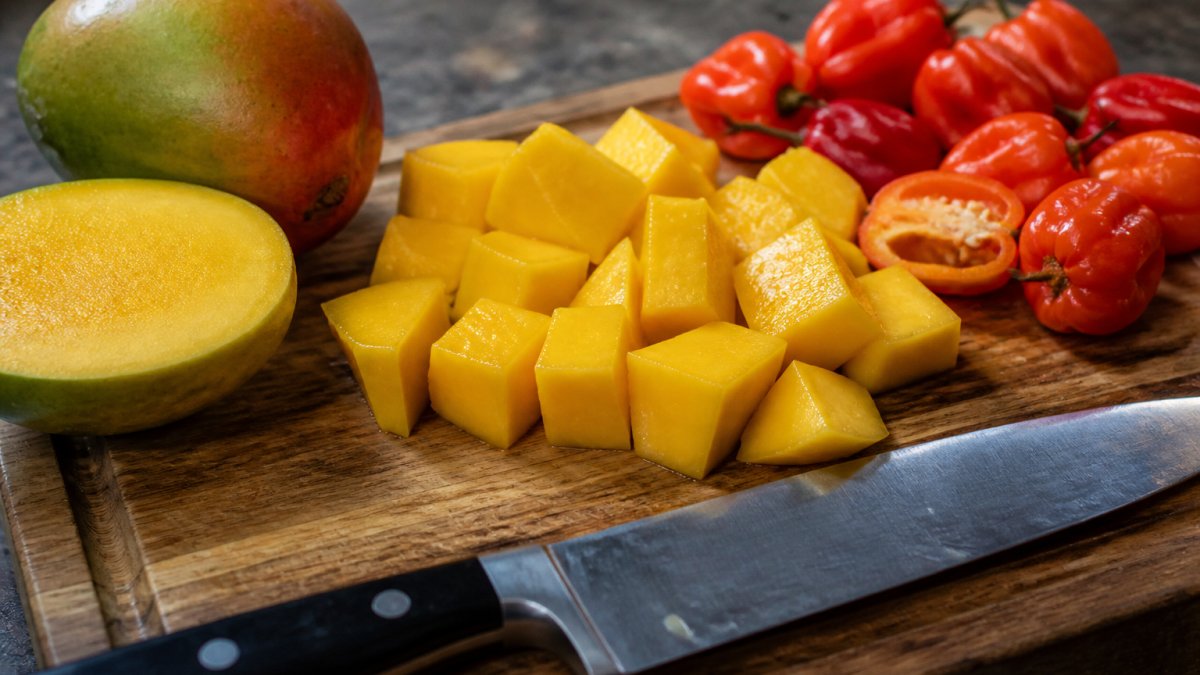
Step 1: Choose Your Fruit Based on Roasting Goals
Start by deciding how much fruit flavor you want relative to heat. This determines which fruit you use and how much.
For a 70% heat, 30% fruit profile, use mango or pineapple, enough substance to show through without overwhelming the peppers.
Step 2: Prepare Fruit for Maximum Flavor Development
Cut fruit into consistent 1- to 2-inch pieces for even roasting, and remove any skin or seeds that would create bitterness.
Pat the fruit dry: surface moisture prevents the browning and caramelization that build complex flavor, and without it roasted fruit tastes flat.
Step 3: Roast or Cook to Build Caramelization
Roast fruit at 375°F for 15 to 25 minutes to develop sugar complexity through caramelization without destroying delicate aromatics, stirring halfway for even heat.
The goal is light browning: dark browning means lost delicate flavors and a move toward burnt, while light browning means sugars have broken down into deeper, more complex compounds.
Underroasted fruit tastes raw and thin; overroasted fruit bitter and one-dimensional.
Step 4: Blend and Adjust Consistency
Blend roasted fruit with your peppers, garlic, and acid (vinegar or citrus juice) at a 2:1 ratio of fruit to peppers by weight.
Taste. If heat dominates, add more fruit. If fruit dominates, add more peppers or acid. Adjust in small increments.
How to Make Hot Sauce Less Spicy Without Losing Flavor
Sometimes you nail the flavor but the heat is too intense. The fix isn't to dilute with water. That weakens everything.
Fruit-Based Solutions for Heat Reduction
Add more fruit. Mango, pineapple, or citrus juice dilutes the concentration of capsaicin while adding flavor volume.
Sweetness masks heat perception. It doesn't reduce actual capsaicin, but it makes the burn feel less intense.
Fats also reduce heat perception.
Balancing Acidity and Sweetness
Acidity cuts through heat and makes it feel sharper rather than overwhelming. Vinegar, lime juice, or citrus juice all work.
Sweetness should balance acidity. Too acidic tastes thin; too sweet tastes cloying. Aim for a point where sweetness and acidity support each other rather than compete.
Mango Chipotle — Castaway Sauce Company →
Mastering Heat Transfer and Airflow During Roasting
Roasting is where most home cooks lose fruit flavor, and the reason is almost always heat transfer, not the recipe. Understanding how heat moves into fruit and peppers lets you control caramelization without cooking off the aromatics you are trying to preserve.
Convection, Conduction, and Radiation
An oven delivers heat three ways, each affecting fruit differently:
- Convection is hot air moving across the surface. It drives evaporation and browning. More airflow means faster surface drying and faster caramelization.
- Conduction is heat moving through the pan and into the food. A heavy sheet pan holds more heat and gives a more even roast. A thin pan creates hot spots.
- Radiation is infrared energy from the oven walls and heating elements. It browns surfaces directly and is strongest at the top of the oven.
A standard home oven at 375°F with the rack in the middle gives you a mix of all three. A convection setting increases airflow and can cut roasting time by roughly 25 percent, so start checking at 12 minutes instead of 15.
Surface Moisture Is the Gatekeeper
Browning cannot begin until surface moisture evaporates, which is why patting fruit dry matters more than most people realize.
A practical test: if the fruit is still releasing visible steam at the 10-minute mark, your pan is too crowded or your fruit is too wet.
Pan Loading and Airflow
Crowding is the single most common roasting mistake. When pieces touch, trapped moisture creates a steam pocket, and the fruit cooks instead of roasts.
Leave roughly half an inch between pieces and use a sheet pan large enough for a single layer with room to spare.
Time and Temperature Targets
These are starting points, not absolutes. Ovens vary, and fruit varies in sugar and water content.
- 15 to 18 minutes at 375°F: light caramelization, preserved aromatics. Best for bright, citrus-forward sauces.
- 20 to 25 minutes at 375°F: deeper caramelization, more complex and less obviously fruity. Best for layered, smoky sauces.
- Beyond 30 minutes: risk of bitterness and loss of delicate top notes. Only go here if you want a dark, jammy character.
Stir once at the halfway point to redistribute heat and release trapped moisture. Rotate the pan 180 degrees if your oven has a known hot spot.
Why This Matters for Heat and Fruit Balance
Roasting does two things at once: it concentrates sugars, pushing fruit flavor forward, and drives off volatile aromatics, pushing fruit flavor back.
That window is narrow, for most fruit, the 15-to-25-minute range at 375°F. Roast shorter and the fruit tastes raw and thin; roast longer and it tastes bitter and one-dimensional.
A Note on Other Contexts
The same principle applies outside hot sauce. In coffee roasting, heat transfer controls how much fruit acidity survives the roast. In grilling, direct vs. indirect heat changes how much fruit character remains in a glaze. The mechanism is the same: heat develops sugar and destroys aromatics, and your job is to find the point where both are present.
Troubleshooting When Heat Masks Fruit Flavor
Sometimes you follow every step and the fruit still disappears. Here's how to diagnose and fix it.
Identifying Over-Extraction of Heat
Over-extraction happens when you roast peppers too long or at too-high temperatures.
Signs: the sauce tastes like pure burn with no complexity, no sweetness, no brightness, no fruit.
Fix: use fresher peppers. Start with a lower roasting temperature (350°F instead of 375°F).
Fixing Watery or Diluted Fruit Character
Watery sauce means fruit wasn't roasted long enough (or at all), or you added too much liquid (vinegar, juice, or water) relative to solids.
Signs: the sauce tastes thin and lacks body, separates easily, and the fruit flavor feels distant and weak.
Fix: roast fruit longer at a higher temperature. Reduce added liquid by 25%.
Tasting and Adjusting Your Sauce for Perfect Balance
The final step is systematic tasting and adjustment. This is where you dial in the exact balance you want.
Building a Flavor Profile Framework
Start by identifying what you taste in order: heat first, then fruit, then acid, then any other notes.
Now adjust one element at a time.
Adjust in small increments. A tablespoon changes the profile noticeably. A teaspoon is barely perceptible.
When to Add More Fruit, Heat, or Acid
Add more fruit when heat dominates and you want fruitiness more present. Add more heat when fruit dominates and you want more intensity.
Keep tasting as you adjust.
The goal is a sauce where no single element dominates.
Frequently Asked Questions
What fruits are best for balancing heat in hot sauce?
Tropical fruits like mango and pineapple work exceptionally well because their natural sweetness and juice content directly counter intense heat. Citrus fruits such as orange and lime add brightness that cuts through spiciness while preserving the sauce's complexity. Stone fruits like peach bring subtle sweetness without overwhelming the flavor profile. The key is choosing fruits with enough sugar and acidity to stand up to the heat without getting lost in the final blend. Roasting these fruits before blending intensifies their character, making them more resilient against the capsaicin intensity.
Does adding fruit to hot sauce make it less spicy?
Adding fruit reduces the perceived heat intensity by introducing sweetness, juice, and acidity that coat your palate and dilute capsaicin concentration. However, the reduction depends on the fruit-to-pepper ratio and the type of fruit used. Mango and pineapple provide the most noticeable cooling effect because of their high water content and natural sugars. Simply adding fruit won't eliminate heat entirely, you're balancing it, not removing it. For sauces that taste too hot, increase the fruit content gradually while reducing the number of hot peppers or their cooking time to preserve the sauce's depth.
How do you know when heat and fruitiness are properly balanced?
Proper balance means the heat builds gradually rather than hitting immediately, and you can identify distinct fruit flavors even as the spice develops. Taste your sauce in stages: first impression should highlight the fruit's sweetness or tartness, mid-palate should introduce the heat, and the finish should show spice without lingering bitterness. If heat dominates from the first taste, add more fruit or increase acidity with citrus juice. If the sauce tastes flat or overly sweet, you may need to increase roasting time to develop caramelization and complexity, or add a pinch more heat source. A well-balanced sauce should make you want another spoonful despite the spice.
What's the best way to roast fruit for hot sauce?
Roast fruit at 400-425°F for 15-25 minutes, depending on size and moisture content. Cut fruit into even pieces to ensure uniform heat transfer and caramelization. Mango and pineapple benefit from longer roasting (20-25 minutes) to develop deep sweetness, while citrus can roast for 12-15 minutes to preserve brightness. Arrange fruit on a baking sheet with peppers if making a complete sauce base, this allows flavors to meld during cooking. Roasting concentrates sugars through evaporation and creates caramelization, which adds complexity that balances intense heat far better than raw fruit.
Creating balanced hot sauce is a skill that improves with practice. You'll develop a feel for how much fruit you need, how long to roast, and when your sauce has hit the right note. Start with our Mango Chipotle or Ball Kicker to see how balance works in practice. Then apply these principles to your own recipes. The more you taste and adjust, the better your instincts become. Get started with Castaway Sauce Company and turn every meal into a flavorful adventure.